About Solar System Model (The Orbit Orrery)
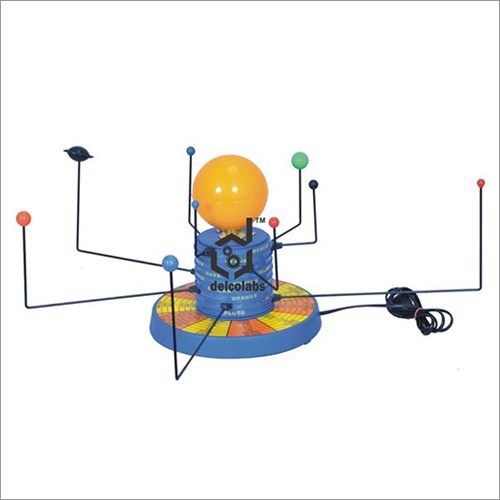
For demonstrating the overall shape of solar system, and the main movements of the planets. The apparatus has all the nine planets of Solar System from Mercury to Pluto on re volving arms with the biggest sphere representing sun positioned at the center. The planets are relative to their size as they appear in the solar system, but not to scale.
Precision Engineering for Science EducationThis Solar System Model, also known as an Orrery, is constructed from stainless steel and mild steel, guaranteeing longevity and precision in scientific demonstrations. Its multicoloured, robust metal components offer a visually engaging representation of planetary movement, supporting both teaching and research purposes in laboratories.
Versatile Applications Across IndustriesDesigned for both industrial and laboratory use, the Orbit Orrery is adaptable to various educational and scientific environments. Its diversity in sizing ensures it caters to a wide range of spatial and instructional needs, making it suitable for institutions looking to enhance their teaching tools.
FAQs of Solar System Model (The Orbit Orrery):
Q: How is the Solar System Model (Orbit Orrery) used in laboratory settings?
A: The model is typically used in laboratories to demonstrate the motion of planets and other celestial objects. By manually rotating or mechanizing the model, users can observe and study the relative orbits, positions, and speeds, facilitating hands-on learning in astronomy and physics.
Q: What materials are used in the construction of the Solar System Model?
A: This model is constructed using high-grade stainless steel and mild steel, ensuring both durability and resistance to corrosion. The use of quality metals makes it suitable for repeated educational and industrial applications.
Q: When is it beneficial to use an Orbit Orrery in educational environments?
A: The Orbit Orrery is highly beneficial during astronomy, physics, or earth science lessons, as it provides a tactile and visual representation of complex astronomical concepts. Its usage enhances students comprehension during demonstrations, experiments, and discussions.
Q: Where can the Solar System Model be implemented effectively?
A: The model is most effective in laboratories, classrooms, and research centersany setting where there is a need for practical illustration of the solar systems mechanics. Its varied size options and durable construction make it adaptable to different spaces.
Q: What is the process of maintaining the Solar System Model?
A: Regular maintenance involves gentle cleaning of the metal components to prevent dust accumulation and occasional inspection for loose parts or signs of wear. Stainless and mild steel provide resilience, but proper care extends the models functional lifespan.
Q: What benefits does the Orbit Orrery offer over conventional teaching aids?
A: Unlike flat diagrams, this 3D model allows users to interact with a realistic representation of planetary motion, improving conceptual understanding. Its sturdy metal construction ensures long-term usability, making it an excellent investment for educational institutions.